
Most small businesses cannot afford a full-time security team, so they buy security as a service. The market is crowded and pricing is rarely published, which makes it hard to tell a fair quote from an inflated one.
Quick answer: Small business cyber security services are outsourced security functions such as 24/7 monitoring, endpoint protection, incident response, security awareness training and compliance support. Provider-published budgets run about $500–$2,500 a month for 1–25 employees, and pricing is usually quoted per user (roughly $50–$250 a month, depending on scope) or per endpoint ($20–$75 a month). All figures here come from providers, so use them as ranges and get written quotes.
Key takeaways
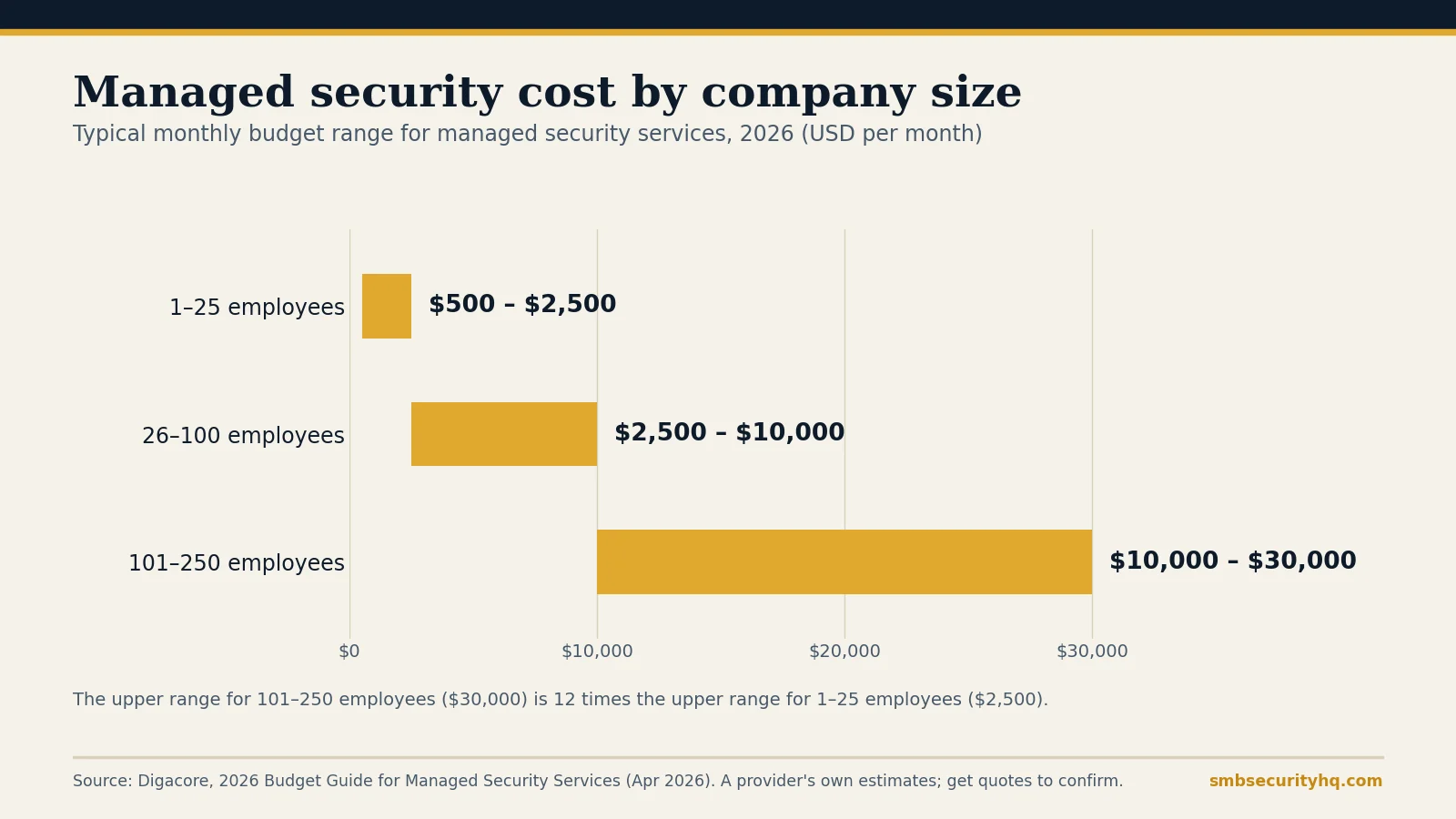
- Budget scales quickly with size. Digacore’s ranges go from $500–$2,500 a month (1–25 employees) to $10,000–$30,000 (101–250 employees).
- Per-user prices overlap and conflict. Published ranges run from $25 to $350 per user a month because providers bundle different things. Compare scope, not price.
- Know what is included. Monitoring, EDR, response, training and compliance help are separate line items at some providers.
- Ask for written scope and exit terms. Avoid long minimum terms that hold your data.
- Insurers care about the same controls. See cyber insurance requirements.
On this page: What they include · Types of provider · Cost · What drives price · Choose a provider · Contract terms · Do you need one? · FAQ
What do small business cyber security services include?
Digacore’s 2026 buyer’s guide lists the core services of a managed security provider as 24/7 threat monitoring, endpoint detection and response (EDR/XDR), SIEM and security operations center (SOC) services, compliance and regulatory coverage, incident response planning, and security awareness training.
In plain English:
- Monitoring: people and tools watch your devices, email and cloud accounts for attacks.
- Endpoint protection (EDR): software on every computer that spots and stops suspicious behavior.
- Response: someone investigates alerts and acts, instead of just emailing you.
- Training: staff learn to spot phishing and scams.
- Compliance help: documentation and controls that match HIPAA, PCI or insurer rules.
Not every provider includes all five. Some sell monitoring only; others bundle everything. The scope, not the brand, decides what you are buying.
Which type of provider do you need?
Four terms get mixed up: MSP, MSSP, MDR and vCISO. Kapacyber describes an MSP as the team that “keeps your IT working” (helpdesk, devices, network), and an MSSP as the team that runs security: tools, monitoring, response and reporting. MDR adds human analysts who actively contain threats, and a vCISO provides part-time security leadership. Our guide, MSP vs MSSP vs MDR vs vCISO, explains which fits which situation.
How much do small business cyber security services cost?
Providers quote in three ways: per company budget, per user, and per endpoint.
Typical monthly budget by company size
| Company size | Monthly budget (Digacore, 2026) |
|---|---|
| 1–25 employees | $500–$2,500 |
| 26–100 employees | $2,500–$10,000 |
| 101–250 employees | $10,000–$30,000 |
Typical pricing by model
| Pricing model | Published range | Source and note |
|---|---|---|
| Per user, basic package | $100–$150 per user per month | Digacore (Apr 2026) |
| Per user, premium package | $225–$350 per user per month | Digacore (Apr 2026) |
| Per user, general | $50–$200+ per user per month | Meriplex (updated Sept 24, 2026) |
| Per employee, SMB-focused | $25–$100 per employee per month; entry point from $425 a month | Kapacyber (May 2026) |
| Per endpoint | $20–$75 per endpoint per month | Meriplex (updated Sept 24, 2026) |
| Managed IT (MSP) incl. security basics | $100–$175 per user per month (15–75 users) | Serenit (May 2026) |
| Compliance add-on | $25–$100 per user per month | Digacore |
| 24/7 coverage add-on | $25–$50 per user per month | Digacore |
Why the ranges disagree: each provider describes a different bundle, a different user count and a different level of response. Kapacyber’s rule of thumb is useful: a price below the normal per-seat range may mean you are buying tools without operations, and a price far above it may mean enterprise overhead.
All of these are provider-published figures, not independent surveys. Treat them as an anchor for questions, and get at least three written quotes with the same scope.
What drives the price?
Meriplex lists five cost drivers: user count, endpoint diversity, compliance requirements, cloud infrastructure and your industry’s risk profile. In practice that means:
- More people and devices cost more.
- Regulated work (healthcare, finance) costs more because of documentation and controls.
- Co-managed vs fully managed. Meriplex notes co-managed services (your IT staff handle fixes) cost less than fully managed ones with 24/7 response and containment.
- Add-ons. Compliance reporting and round-the-clock coverage are often extra.
- Onboarding. Some providers charge setup fees; ask.
How do you choose a provider?
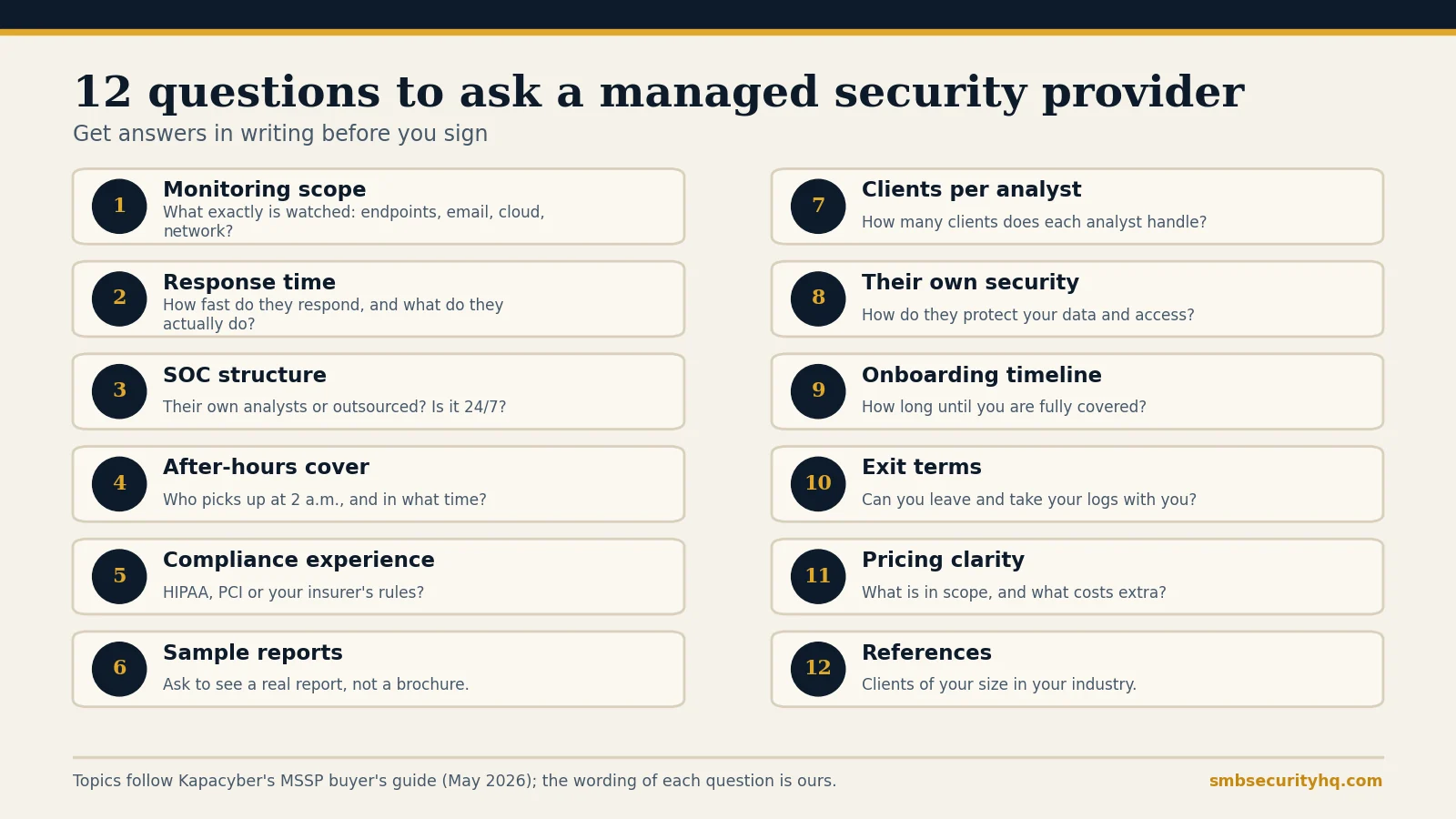
Kapacyber’s buyer’s guide uses a twelve-question test. We turned its topics into a checklist you can take to every sales call. Ask for answers in writing.
Red flags to watch for:
- “Contact us for a quote” and nothing else. A good provider can show a sample scope.
- No named services. “Comprehensive security” is not a scope.
- No sample report. Ask to see one.
- Pressure to sign multi-year terms.
What contract terms should you look for?
Kapacyber recommends transparent pricing, named services with clear in-scope and out-of-scope items, no data lock-in (you can leave and retrieve your logs), and no multi-year minimums that hold your data hostage. Add two of our own: a written response time in hours, and a named contact for incidents.
Do you need security services, or can you do it yourself?
Many very small businesses can start with the basics: enforced MFA, endpoint protection, tested backups and staff training. Our cybersecurity checklist and cyber insurance readiness check show where you stand. Consider paid services when:
- you have no one who can respond to an alert at night or on weekends;
- an insurer, customer or regulator is asking for evidence of monitoring;
- you handle sensitive data (health, financial, legal).
If your gap is leadership rather than tools, a part-time security executive may fit better: see vCISO and cybersecurity consulting costs.
Frequently asked questions
How much do cybersecurity services cost for a small business?
Provider-published budgets run about $500–$2,500 a month for 1–25 employees (Digacore, 2026). Per-user pricing is commonly quoted between about $50 and $250 a month depending on scope, though published ranges overlap and conflict.
What is the difference between an MSP and an MSSP?
An MSP keeps your IT working (helpdesk, devices, network). An MSSP runs security: tools, monitoring, response and reporting (Kapacyber). See our comparison.
What does 24/7 monitoring cost?
Digacore lists 24/7 coverage as an add-on of about $25–$50 per user a month. Some providers include it in higher tiers.
Is per-user or per-endpoint pricing cheaper?
It depends on how many devices each person uses. Per-endpoint pricing ($20–$75 per endpoint per month, Meriplex) can cost more for staff with several devices; per-user pricing can cost more for shared devices.
Can a small business get cyber insurance without managed security?
Often yes, but insurers ask about controls such as MFA, EDR and backups. See cyber insurance requirements.
What should be in the contract?
Named services, response times, reporting, data portability on exit, and no long lock-in terms.
How long does onboarding take?
It varies. Ask each provider for a written timeline.
Sources
- Digacore: 2026 Budget Guide, Managed Security Services Provider (Apr 3, 2026; updated Apr 7, 2026)
- Meriplex: How Much Do Managed Security Services Cost in 2026? (Feb 12, 2026; updated Sept 24, 2026)
- Kapacyber: MSSP for Small Business, 2026 Buyer’s Guide (May 15, 2026; modified July 10, 2026)
- Serenit: MSP Pricing Guide 2026 (updated May 18, 2026)
Last updated October 5, 2026. All prices are published by providers that sell these services and are not independent surveys; they change often. SMB Security HQ provides general information, not legal, financial or professional security advice. See our Affiliate Disclosure and How We Test.