
The best cyber policy is the one whose coverage matches how your business actually loses money, at a price you can afford. This page compares four well-known insurers using published sources, and shows what to check before you buy. For what cyber insurance is and what it covers, start with our small business cyber insurance guide.
Key takeaways
- Cheapest is not best. Social engineering and funds-transfer cover, breach response limits and exclusions matter more than the premium.
- Quotes beat averages. MoneyGeek’s figures are modeled; your price depends on industry, size and controls.
- Insurers want controls. MFA, endpoint protection, backups and training affect price and eligibility: see cyber insurance requirements.
- We have not bought or claimed on these policies. This is a comparison of published information.
On this page: Compared · Chubb · Hiscox · Coalition · Travelers · What to check · How to get quotes · FAQ
How do the main insurers compare?
| Insurer | MoneyGeek score (of 5) | Avg. monthly premium (modeled) | How it is sold | Standout |
|---|---|---|---|---|
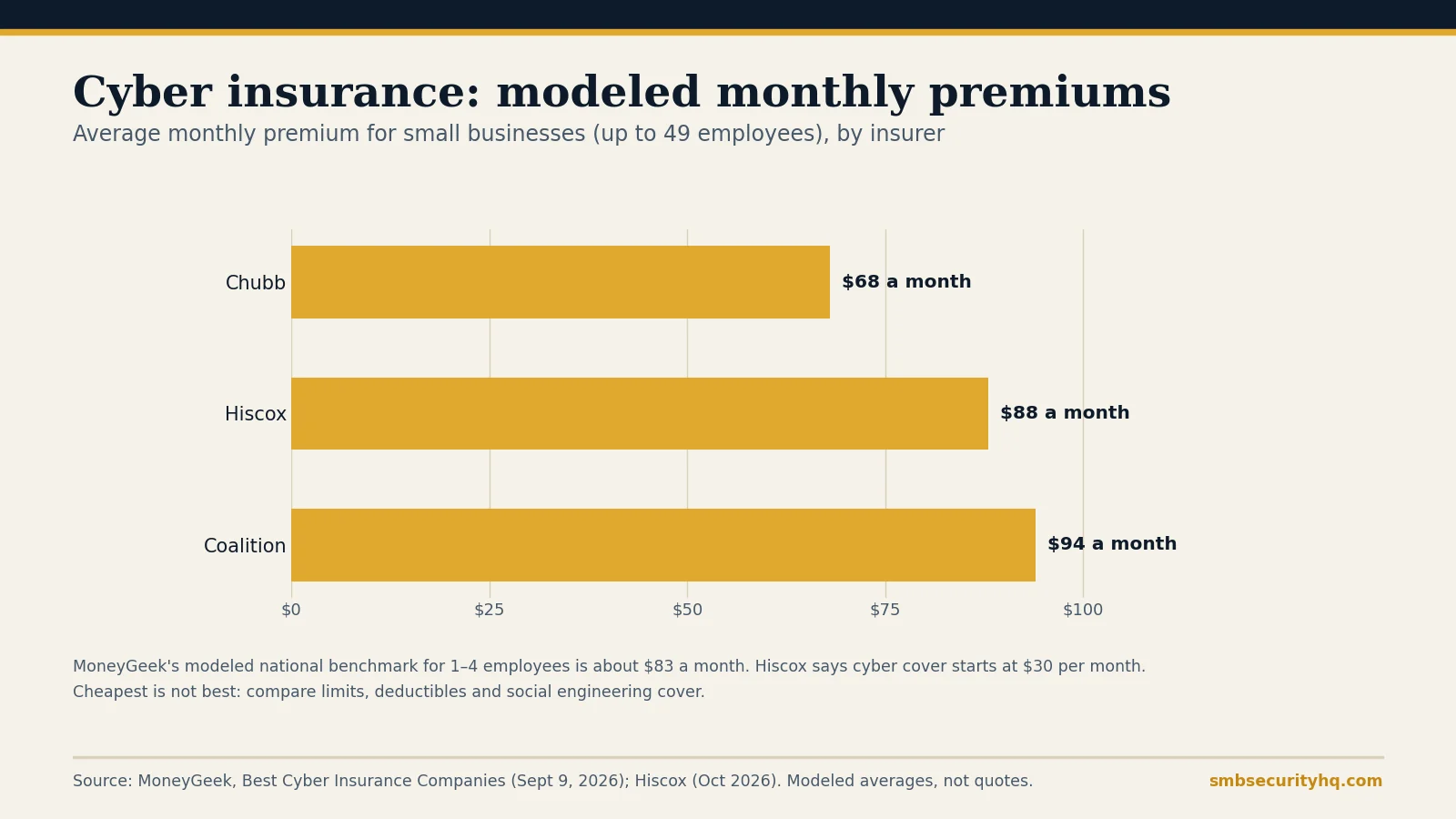
| Chubb | 4.66 | $68 | Agents and brokers | Lowest modeled premium; top-rated claims service per MoneyGeek |
| Hiscox | 4.15 | $88 | Online quote or licensed agent | Highest score for cyber crime and social engineering cover per MoneyGeek |
| Coalition | 4.09 | $94 | Partner insurers; risk assessment on its site | Security tools and incident response for policyholders |
| Travelers | Not in MoneyGeek’s top three | Not published | Agents | CyberRisk policy for small to large businesses |
MoneyGeek weights affordability at 50%, customer experience at 30% and coverage options at 20%, using modeled data for businesses with up to 49 employees. The score therefore leans toward price. Its national benchmark for 1 to 4 employees is about $83 a month (modeled, $1 million limit, $1,000 deductible).
Chubb
MoneyGeek rates Chubb first, praising affordable coverage, flexible coverage selection and claims service, and noting it is less competitive for fully digital buying and has no built-in threat scanning. It is generally bought through an agent or broker, so ask for quotes rather than expecting a price on a website.
Hiscox
Hiscox lets you get a quote online in minutes or through a licensed agent. It says cyber insurance starts at $30 a month and gives examples of $29.57 a month for a Texas business consultant and $42.73 a month for a Massachusetts accountant, both with $250,000 limits and a $10,000 deductible. Included: data breach response, cyber extortion and ransomware, business interruption and data recovery. Cyber crime protection (social engineering and fraudulent funds transfer) is an optional add-on, and unauthorized funds transfers are excluded unless you add it. Coverage is not available in every state or class of business.
Disclosure: we may earn a commission if you request a quote through this Hiscox link, at no cost to you. It does not change our assessment. See our Affiliate Disclosure.
Coalition
Coalition combines insurance with security tools. Its site lists Coalition Control, an on-call incident response affiliate, security awareness training and a separate breach response limit, plus coverage for ransomware payments and recovery of funds lost to funds-transfer fraud. MoneyGeek notes it is sold through partner insurers, has the highest modeled premium of the three, and has strong risk-management tools. Coalition’s own claims report is a useful read: see what cyber insurance costs.
Travelers
Travelers’ CyberRisk policy is described as suitable for small businesses to Fortune 500 companies, with options for forensic investigation, regulatory defense, business interruption, cyber extortion and crisis management, and it is bought through an agent. The page gives no limits or prices, so you will need a quote. It may suit businesses that already work with a Travelers agent.
What should you check before you buy?
| Question | Why it matters |
|---|---|
| Is funds-transfer or social engineering fraud covered, and what is the sublimit? | Business email compromise and funds-transfer fraud were 58% of Coalition’s 2026 incidents |
| What are the breach response limits, and are they separate from the main limit? | Forensics and notification costs can use up a shared limit |
| What is the deductible and waiting period for business interruption? | It decides what you pay before cover starts |
| What exclusions apply (prior incidents, third-party systems, war, unencrypted data)? | Exclusions decide whether a claim pays |
| Which security controls does the application require (MFA, backups, EDR)? | A wrong answer can void a claim |
| Is there a panel of forensic and legal firms, and a 24/7 claims line? | Speed matters in an incident |
Our guide to cyber insurance requirements lists the controls insurers ask for, and the free readiness check shows your gaps before you apply.
How do you get quotes?
- Fix the gaps that raise price (MFA, backups, endpoint protection) before applying.
- Get at least three quotes with the same limit and deductible, for example the $1 million and $1,000 MoneyGeek used for its models.
- Use a broker if you want Chubb, Travelers or other agent-sold carriers compared for you.
- Read the application carefully. Answer honestly, and keep evidence of your controls.
- Know what to do after an incident, including notifying your insurer early: what to do after a data breach.
Frequently asked questions
Who has the best cyber insurance for small business?
It depends on your risk. MoneyGeek ranked Chubb first, then Hiscox and Coalition, with a scoring method that favors price. Compare coverage and fraud cover on real quotes.
How much does cyber insurance cost for a small business?
MoneyGeek’s modeled benchmark is about $83 a month for 1 to 4 employees, and its insurer averages range from $68 to $94 a month. Hiscox says cover starts at $30 a month. Your quote will vary.
Does cyber insurance cover social engineering and fake invoice fraud?
Sometimes. Hiscox, for example, sells it as an optional cyber crime add-on. Check the sublimit and any verification conditions in the policy.
Is Coalition cyber insurance good for small businesses?
MoneyGeek praises its risk tools and buying experience but notes it had the highest modeled premium of the three it ranked. It includes services such as incident response and security awareness training, per its site.
Can I buy cyber insurance online?
Some insurers, such as Hiscox, offer online quotes. Others, such as Travelers and Chubb, work through agents and brokers.
Do I need cyber insurance if I have security tools?
Tools reduce the chance of a loss, and insurance helps pay for the loss you cannot prevent. Many businesses buy both.
Sources
- MoneyGeek: Best Cyber Insurance Companies (2026 Picks) (Sept 9, 2026)
- MoneyGeek: Cyber insurance cost (updated Oct 15, 2026)
- Hiscox: Cyber insurance
- Coalition: Cyber insurance; Coalition: 2026 Cyber Claims Report
- Travelers: Cyber insurance
Premiums are modeled averages from the sources named, not quotes. Coverage varies by state and policy; read the policy wording. SMB Security HQ is not an insurance agency, broker or adviser and provides general information only. See our Affiliate Disclosure and How We Test.