

Key takeaways
- Losses can be large relative to a small firm. A $116,000 average claim (insured businesses) is a lot for a small company.
- Fraud is the leading incident type. Business email compromise and funds transfer fraud made up 58% of Coalition’s incidents.
- Insurance helps, but does not replace controls. Insurers ask about them.
- Basics go a long way. See essential security controls.
On this page: Costs · Common incidents · Beyond money · What to do · FAQ
What does an incident cost?
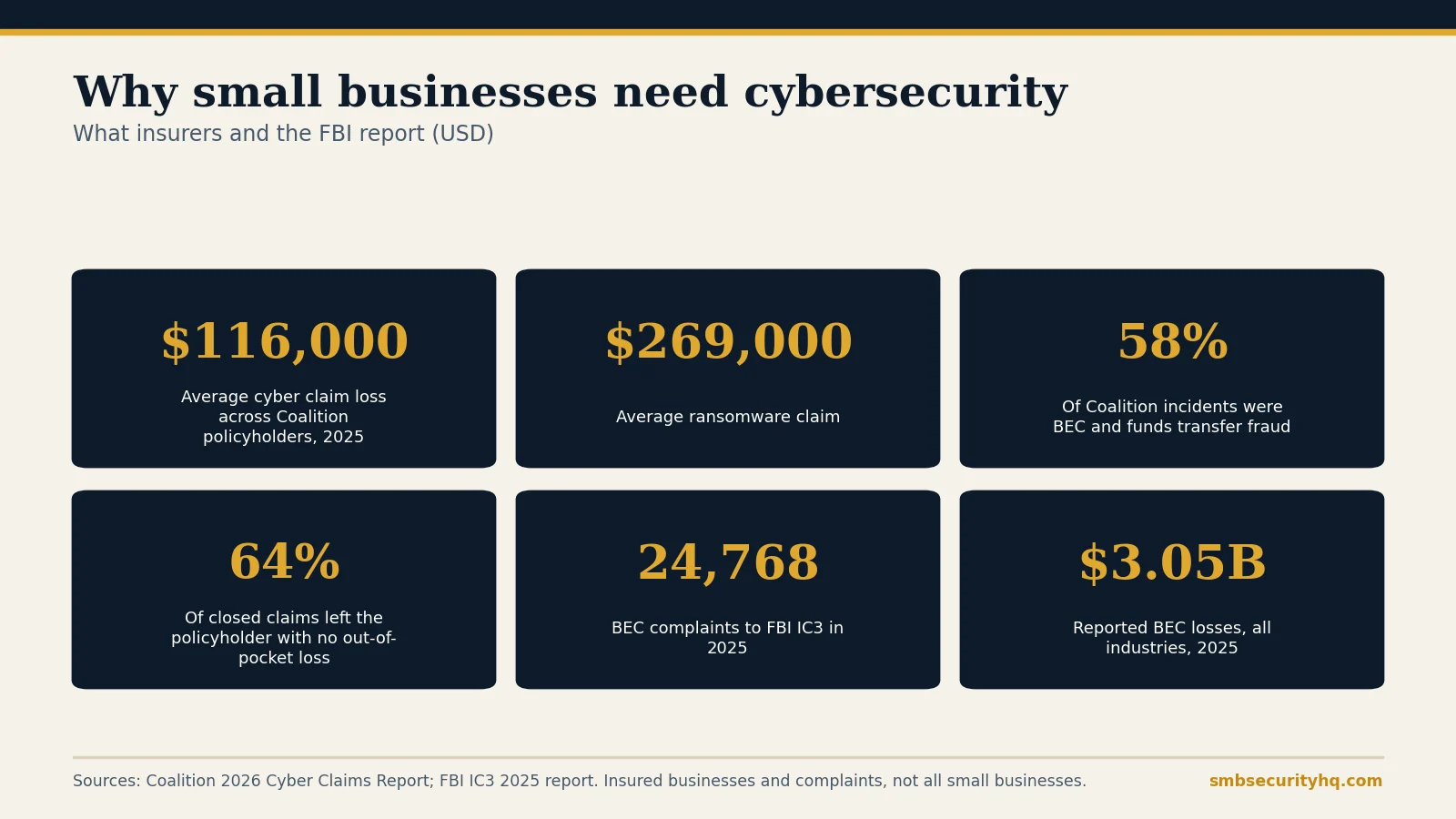
Coalition’s 2026 Cyber Claims Report found an average claim loss of $116,000 in 2025, with ransomware at $269,000 and funds transfer fraud at $141,000. It also found that 64% of closed claims ended with no out-of-pocket loss for the policyholder, which shows what insurance can do. The FBI’s IC3 recorded 24,768 business email compromise complaints in 2025 with about $3.05 billion in reported losses, across all industries. See cyber insurance cost.
Which incidents are most common?
- Business email compromise and payment fraud: 58% of Coalition’s incidents. Read BEC explained.
- Ransomware: the costliest claim type in Coalition’s data. See ransomware protection.
- Exploited vulnerabilities: the most common way in, at 31% of breaches in Verizon’s 2026 DBIR.
- Human error: the human element was involved in 62% of breaches (DBIR).
What else is at stake besides money?
- Downtime: you cannot invoice, ship or treat patients while systems are locked.
- Customer trust and contracts: clients and insurers increasingly ask about your controls.
- Legal duties: health, financial and other data can bring notification and security rules. See the compliance guide.
What should a small business do first?
- Turn on MFA for email and admin accounts.
- Set up tested backups.
- Keep devices updated and add endpoint protection.
- Train staff on phishing and payment checks: awareness training.
- Write an incident response plan.
For a full plan, see how to build a security program, and for costs, how much cybersecurity costs.
Frequently asked questions
Why is cybersecurity important for small businesses?
Because common attacks such as payment fraud and ransomware can cause losses that are large for a small firm and do not depend on the target being famous.
How much does a cyber attack cost a small business?
Coalition’s 2026 report shows an average claim of $116,000 across insured businesses, with ransomware averaging $269,000. Individual costs vary widely.
What is the most common cyber threat to small businesses?
In Coalition’s data, business email compromise and funds transfer fraud together were 58% of incidents.
Can a small business afford cybersecurity?
Many key steps are free settings or low-cost tools. See our cost guide.
Does cyber insurance replace security?
No. Insurers ask for controls such as MFA and backups, and may decline or charge more without them.
Where should I start?
With MFA on email and admin accounts, then backups and updates.
Sources
SMB Security HQ provides general information, not legal, financial or professional security advice. See our Affiliate Disclosure and How We Test.