

Key takeaways
- Attackers go where it is easy. Unpatched systems and tricked staff are the usual routes.
- The data is not split cleanly by size. Be careful with claims that say “X% of attacks hit small businesses.”
- Fraud is common. Payment redirection does not need malware.
- Fixing basics lowers your odds.
On this page: Targeted? · How breaches start · What we cannot say · Defend · FAQ
Are small businesses really targeted?
Small businesses are attacked, but the evidence we reviewed does not show that attackers choose them by size. Much of what reaches a small firm is broad: mass phishing, automated scans and fraudulent invoices. A weak password or an unpatched server is enough.
How do breaches actually start?
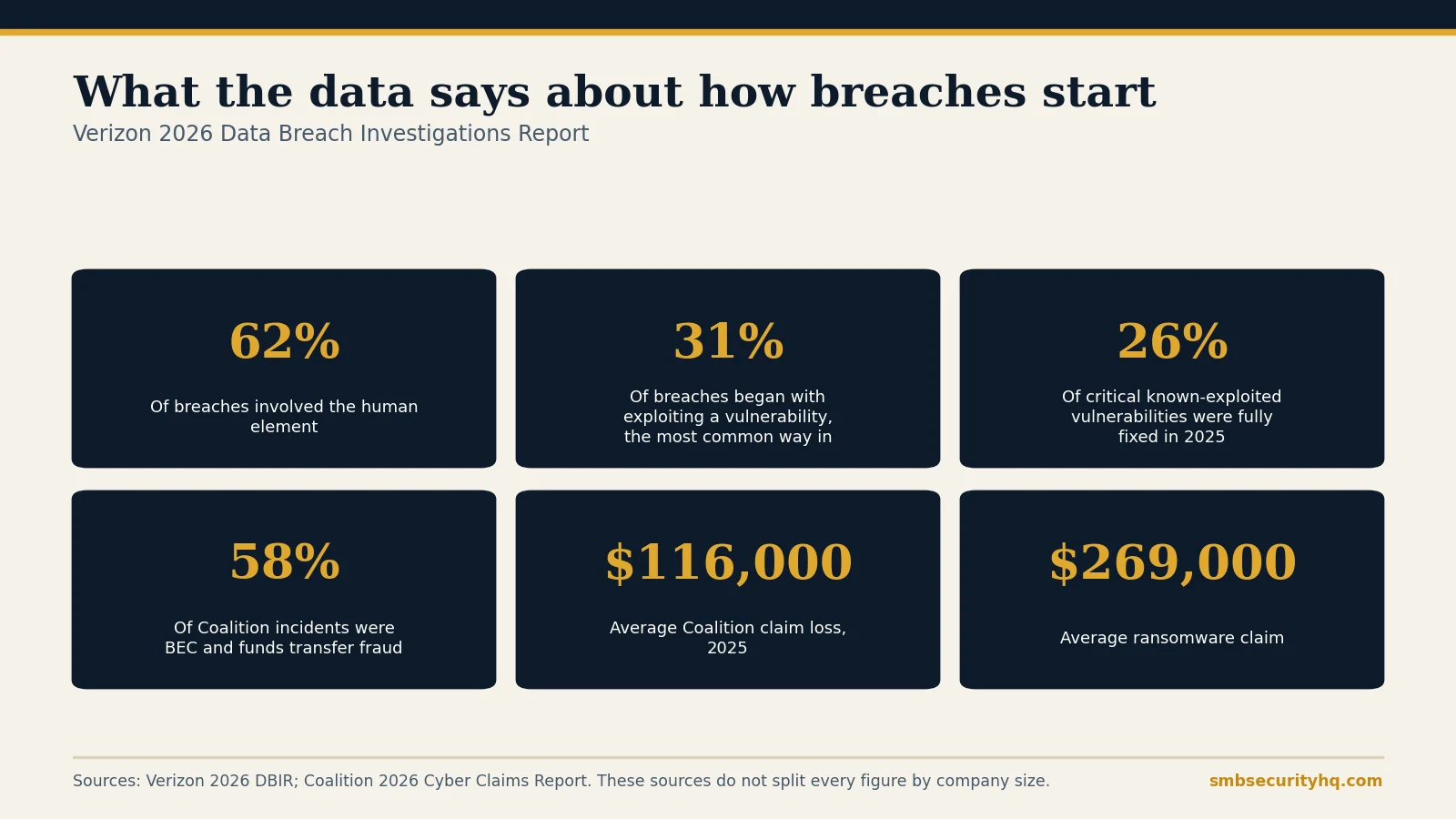
- Verizon’s 2026 DBIR says the human element was involved in 62% of breaches.
- Exploiting a vulnerability was the most common way in, at 31% of breaches, and only 26% of critical known-exploited vulnerabilities were fully fixed in 2025.
- Coalition’s 2026 report found business email compromise and funds transfer fraud made up 58% of incidents, with an average claim of $116,000 and ransomware claims averaging $269,000.
What can we not say?
We have not found a reliable source in this research that states what share of all attacks hit businesses of a given size, so we do not quote one. Coalition’s figures describe its insured customers, and the FBI’s figures describe complaints from all sectors. Treat any statistic that lacks a named source and method with caution.
What should you do about it?
- Patch: automatic updates and replacing unsupported software.
- Protect logins: MFA and a password manager.
- Train staff to spot phishing and verify payment changes: how to spot a phishing email.
- Back up and test restores: backup strategy.
- Plan: first response after a breach.
Related: why small businesses need cybersecurity.
Frequently asked questions
Do hackers target small businesses?
Small businesses are attacked, often through opportunistic methods such as phishing, fraud and scans for unpatched systems, rather than being singled out by name.
What is the most common way attackers get in?
In Verizon’s 2026 DBIR, exploiting a vulnerability was the most common initial route at 31% of breaches.
How much of cybercrime is aimed at small businesses?
We do not cite a figure because we could not verify a reliable, sourced share by company size.
Are small businesses more at risk than large ones?
They often have fewer security staff, but the data we reviewed does not rank risk by size. Your own controls matter most.
What attack should I worry about most?
Payment fraud and ransomware, based on Coalition’s incident and claim data.
What is the cheapest defense?
MFA and automatic updates, both often free in tools you already use.
Sources
SMB Security HQ provides general information, not legal, financial or professional security advice. See our Affiliate Disclosure and How We Test.


