
Cybersecurity is not one purchase. It is a handful of small subscriptions, a few free settings and, if you choose, a provider who watches your systems. Adding them up is easier than most pricing pages suggest.
Quick answer: A 10-employee business with 12 computers can cover the cybersecurity basics (password manager, backup, managed endpoint protection, staff training and cyber insurance) for roughly $337 to $672 a month, or about $4,000 to $8,100 a year, based on prices published in October 2026. Fully managed security services cost more: Digacore publishes $500 to $2,500 a month for 1 to 25 employees. Your total depends on size, tools and how much you outsource.
Key takeaways
- The basics are cheap relative to the risk. Coalition’s 2026 claims report puts the average cyber insurance claim at $116,000 and ransomware claims at $269,000 (insured businesses, 2025).
- Endpoint protection with monitoring is the biggest line item ($10 to $30 per computer a month, CyberMark).
- Managed security costs several times more than a do-it-yourself stack, but includes people who respond.
- Many protections are free: MFA, patching, encryption and a written incident plan cost time, not licences.
- Prices change. All figures were published by the vendors named below and checked on October 5, 2026.
On this page: The basics · Line items · Managed security · Free steps · Hidden costs · Budget by size · Is it worth it? · FAQ
How much should a small business spend on cybersecurity?
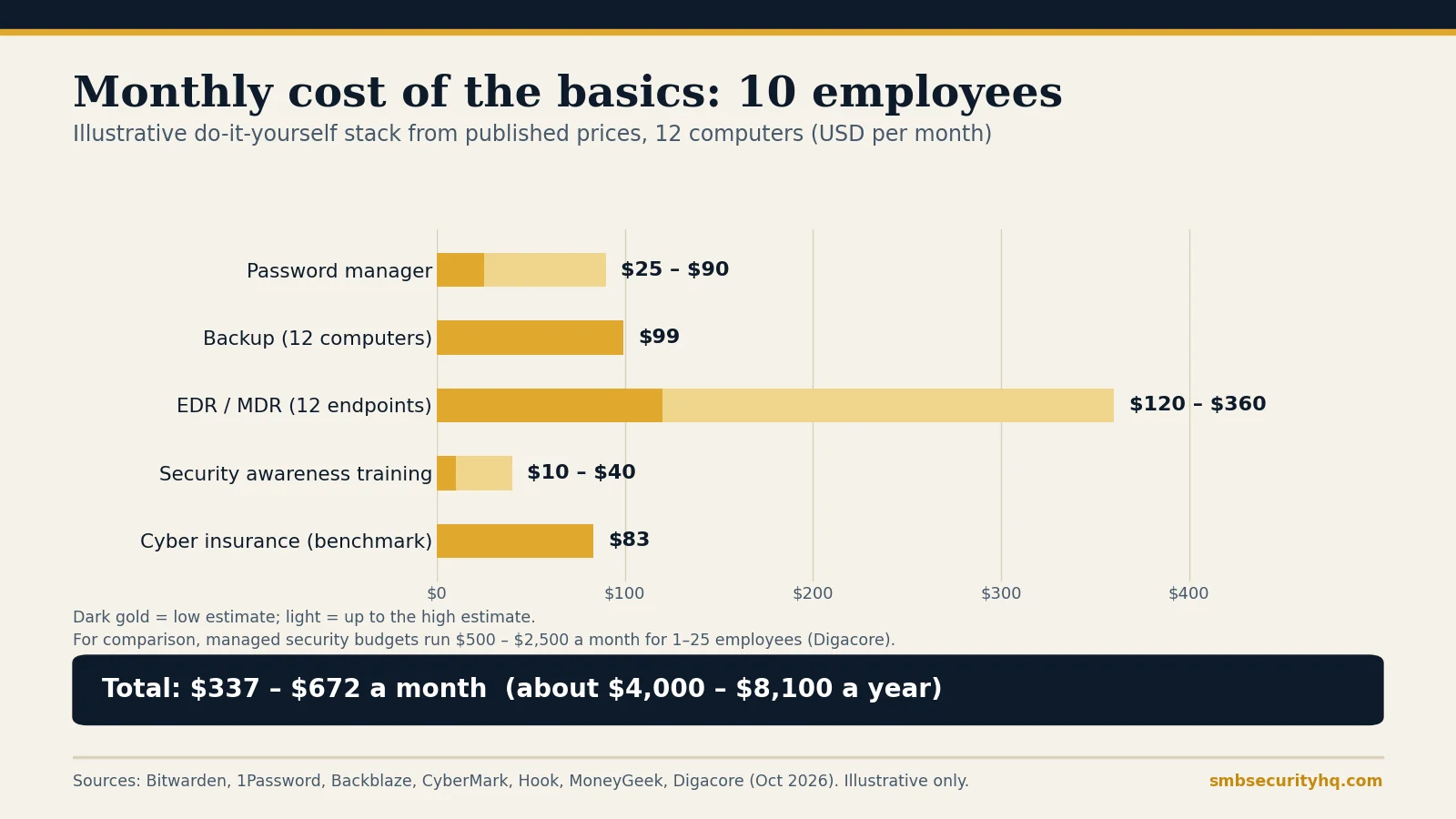
There is no single correct budget, so we built an illustrative one. The example business has 10 employees and 12 computers. We priced the five items most small-business guidance and insurers care about, using published vendor prices.
What does each item cost?
| Item | How we priced it | Monthly cost (10 employees, 12 computers) |
|---|---|---|
| Password manager | 1Password Teams Starter Pack, $24.95 a month for up to 10 users, up to Business at $8.99 per user a month (annual billing). Bitwarden Teams is $4 per user a month, about $40 | $25 to $90 |
| Backup | Backblaze Business Backup, $99 per computer per year, 12 computers | $99 |
| Endpoint protection with monitoring (EDR or MDR) | CyberMark: $10 to $30 per endpoint per month, 12 endpoints | $120 to $360 |
| Security awareness training | Hook Security says typical pricing is $1 to $4 per user per month, 10 users | $10 to $40 |
| Cyber insurance | MoneyGeek’s September 2026 benchmark for 1 to 4 employees is about $83 a month; premiums are about 45% higher for 5 to 9 employees | $83 or more |
| Total | about $337 to $672 |
The math: low = $24.95 + $99 + $120 + $10 + $83 = $336.95; high = $89.90 + $99 + $360 + $40 + $83 = $671.90. Multiply by 12 for $4,043 to $8,063 a year.
What is not in this total: your own time, a business firewall or router, email security filtering, a vCISO or consultant, penetration tests, and any compliance work. The insurance line is a floor, because the benchmark is for 1 to 4 employees; see what cyber insurance costs.
What do managed security services cost instead?
If nobody on your team can respond to an alert at 2 a.m., you may buy security as a service. Provider-published budgets from Digacore are $500 to $2,500 a month for 1 to 25 employees, $2,500 to $10,000 for 26 to 100, and $10,000 to $30,000 for 101 to 250. Per-user prices published by providers range from about $25 to $350 a month, depending on what is bundled. Full breakdown: small business cyber security services and our cost estimator.
The trade-off: the do-it-yourself stack above gives you tools; managed services give you tools plus people who investigate and respond. Which you need depends on whether you have anyone to act on alerts. See MSP vs MSSP vs MDR vs vCISO.
Which cybersecurity steps are free or nearly free?
NIST’s Small Business Quick-Start Guide lists priorities that cost little or nothing beyond time:
- Multi-factor authentication on all accounts. Check whether your email or productivity plan already includes it.
- Changing default passwords on routers, printers and cameras.
- Updating and patching software and operating systems.
- Full-disk encryption on laptops and tablets (built into modern Windows and macOS).
- A basic incident response plan written before an incident.
- Free templates: the Cyber Readiness Institute’s Core Four policy template, or our policy generator.
Work through them with the 12-step checklist.
What costs do small businesses forget?
- Staff time to set up, test restores and run training.
- Hardware such as a business-grade firewall.
- Email security filtering on top of your mailbox’s basic spam filter.
- Specialist work: ZipSec lists penetration tests at $10,000 to $50,000 or more and SOC 2 audits at $15,000 to $100,000, which most small businesses do not need.
- Consulting or a vCISO: about $1,500 to $5,000 a month for companies of 1 to 50 employees (SideChannel, ZipSec). See vCISO costs.
How do costs scale with the size of your business?
Per-user and per-device items scale linearly: a password manager, training and endpoint protection cost roughly the same per person or computer at 5 or 50 employees. Fixed items such as insurance and a managed-security minimum do not. A simple way to budget: take the per-user items in the table, multiply by your headcount and device count, then add insurance and any managed service. Use the cost estimator for managed-service ranges at your size.
Is cybersecurity worth the cost?
Coalition’s 2026 Cyber Claims Report puts the average loss per claim at $116,000 across its policyholders in 2025, with ransomware at $269,000 and funds transfer fraud at $141,000. These are insured businesses and not a forecast for any single company, and most never file a claim. The question is whether your business could absorb a five- or six-figure loss. If not, spending $4,000 to $8,000 a year on the basics is a reasonable trade, and several of these items are also what insurers ask for: see cyber insurance requirements.
Frequently asked questions
How much does cybersecurity cost for a small business per month?
For a 10-employee business with 12 computers, about $337 to $672 a month for the basics (password manager, backup, managed endpoint protection, training and cyber insurance), based on published vendor prices in October 2026. Managed security services start higher: $500 to $2,500 a month for 1 to 25 employees (Digacore).
How much should a small business budget for cybersecurity?
Start from the per-user and per-device prices above for your headcount, then add insurance and any managed service. There is no universal percentage, and we have not verified an independent benchmark, so we do not quote one.
What is the cheapest way to improve cybersecurity?
Enforce MFA, fix passwords, turn on updates, enable device encryption, and test your backups. These are NIST priorities and mostly cost time.
Do I need a managed security provider?
Only if nobody can monitor and respond to alerts. If you do, compare providers by scope and response time, not price alone.
Is cybersecurity tax deductible?
Business security spending is often deductible as an expense, but rules vary. Ask your accountant.
Why do prices vary so much?
Providers bundle different services, devices and response levels. Compare scope, not just price.
Sources
- 1Password: pricing and Bitwarden: business pricing (checked Oct 5, 2026)
- Backblaze: Business Backup pricing (checked Oct 5, 2026)
- CyberMark: Managed Detection and Response Cost in 2026 (June 29, 2026)
- Hook Security: Best Security Awareness Training for Small Business (vendor blog)
- MoneyGeek: cyber insurance cost (updated Sept 10, 2026)
- Digacore: 2026 Budget Guide, Managed Security Services Provider (Apr 2026)
- Coalition: 2026 Cyber Claims Report (Mar 5, 2026)
- NIST: Small Business Quick-Start Guide, SP 1300 (Feb 2024)
- SideChannel and ZipSec vCISO pricing (2026)