
Key takeaways
- “Never trust, always verify” is the slogan; the practice is checking identity and device every time.
- You likely already do part of it with MFA and cloud apps.
- Beware of labels. Zero trust is a strategy; no single product delivers it.
- Start with identity. MFA and least privilege first.
On this page: Definition · Ideas · Steps · Cost · FAQ
What does zero trust mean?
Traditional security treated the office network as trusted and the internet as untrusted. That breaks down with remote work, personal devices and cloud apps. NIST’s SP 800-207, published in August 2020, describes zero trust as an evolving set of paradigms that move defenses from static network-based perimeters to users, assets and resources, and says network location alone does not earn trust. CISA describes it as reducing uncertainty in making accurate, least-privilege, per-request access decisions when the network is treated as compromised, and notes it may require a cultural change.
What are the core ideas?
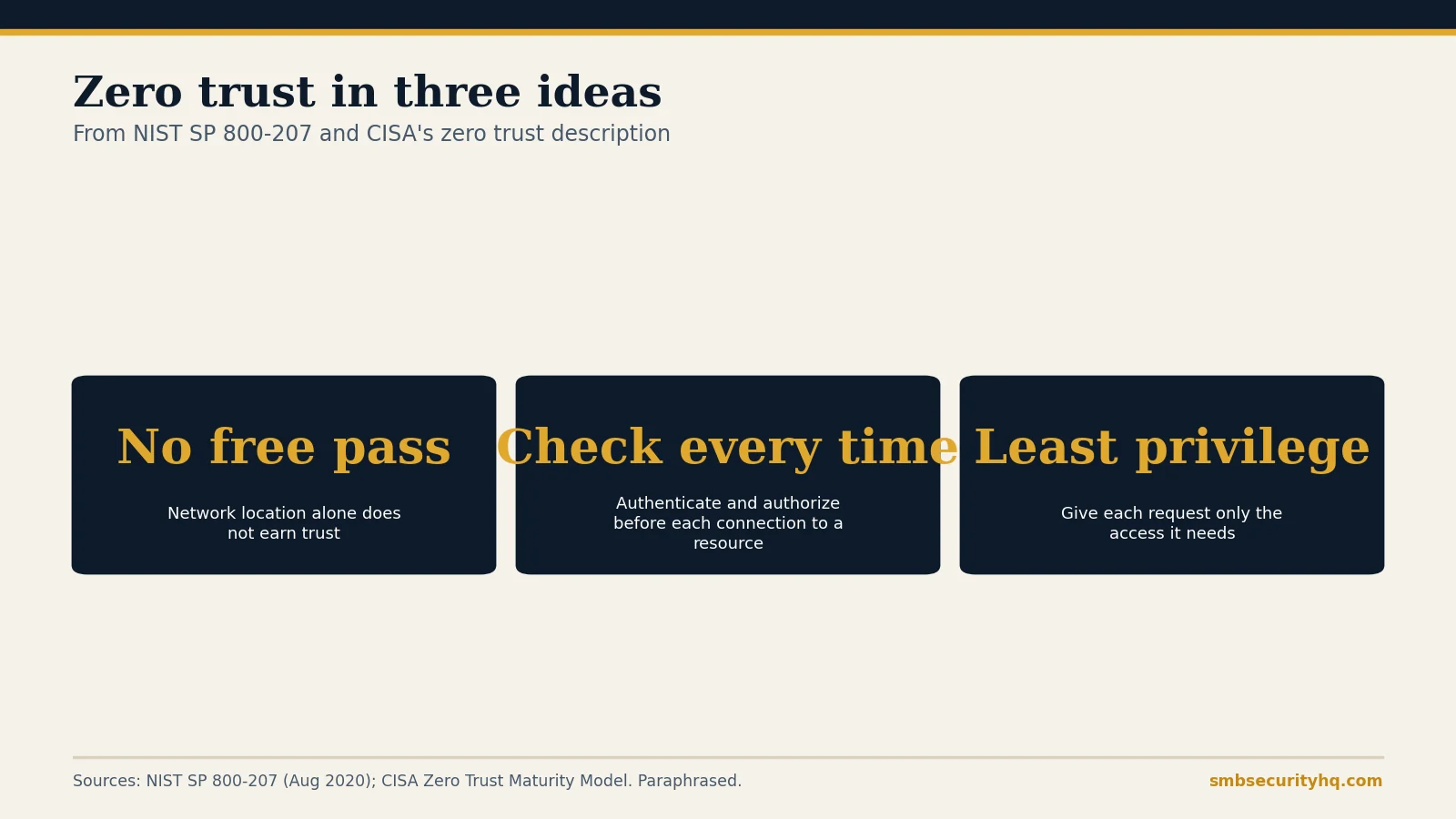
CISA’s Zero Trust Maturity Model organizes the work into five pillars and shows traditional, advanced and optimal examples for each. It is written for large organizations; small businesses can borrow the logic.
How can a small business apply it?
- Verify identity strongly: MFA on all accounts that offer it.
- Least privilege: give people only the access their job needs, separate admin accounts, remove access when people leave.
- Know your devices: keep an inventory and require updates and endpoint protection.
- Protect data where it lives: cloud sharing settings, backups.
- Watch and respond: alerts and an incident plan.
This lines up with essential security controls. Compare it to the older approach in do you need a VPN.
Does zero trust cost a lot?
Not necessarily. Many of the building blocks (MFA, conditional access, device management) are included in suites you may already own. Check what your plan includes before buying anything labeled “zero trust.”
Frequently asked questions
What is zero trust in simple terms?
A model that verifies each user and device before granting access, instead of trusting anything on the internal network.
Is zero trust a product I can buy?
No. It is a strategy built from controls such as MFA, least privilege and device checks.
Do small businesses need zero trust?
The principles help any business, especially with remote work and cloud apps. You can adopt them gradually.
What is the first step?
MFA on email and admin accounts, then least-privilege access.
Does zero trust replace a VPN?
Not automatically. They can work together; see our VPN guide.
What is NIST SP 800-207?
NIST’s zero trust architecture publication, finalized in August 2020.
Sources
SMB Security HQ provides general information, not legal, financial or professional security advice. See our Affiliate Disclosure and How We Test.